

Idea → researched plan, in one sitting
Ten departments read the web,
then write your startup plan.
Describe the idea once. The system researches nine topics on the live web — competitors, market size, licences, costs, funding — then ten AI departments write their own report from that same evidence. Every figure carries the source it came from.
01/What actually happens
- 01
You describe the idea in your own words
A refiner turns the paragraph into a locked brief: the wedge, the archetype, the country, the customer. Every department then reasons from the same starting point instead of inventing its own.
- 02
Nine research topics run against the live web
Competitors and their real prices, market size, licences and tax, channels and their costs, funding programmes, infrastructure rules. Answers come back with dated sources, and what could not be verified is written down as unverified.
- 03
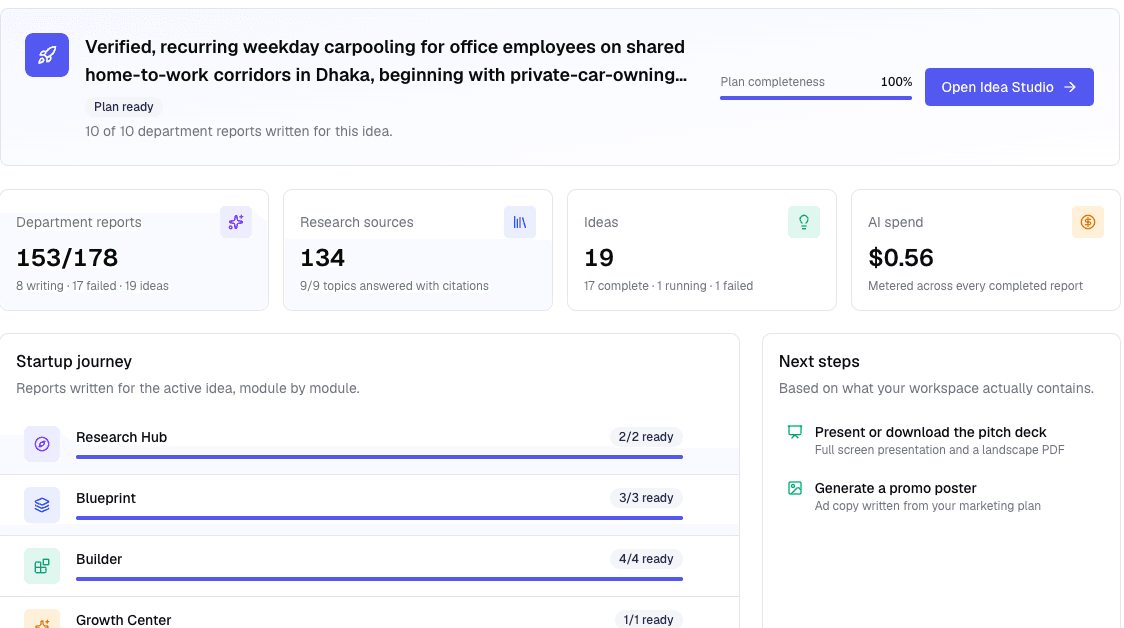
Ten departments write in parallel, under one budget
Each department reserves its worst-case cost before it runs. When the cap or the five-minute deadline is close, the run stops starting new work and keeps what is finished — no silent overspend, no half-written report pretending to be whole.
- 04
You leave with documents, not a chat log
Reports open as structured documents, the deck presents full screen and exports as a real PDF, the marketing plan turns into poster copy. All of it downloadable.
02/The departments
Ten of them. Each writes one document, properly.
A bakery does not need a frontend plan. When the brief says the idea is not software, the engineering departments are dropped and the rest go deeper instead.
Idea Validation
AI Analyst
Scores feasibility, names the risks that kill it
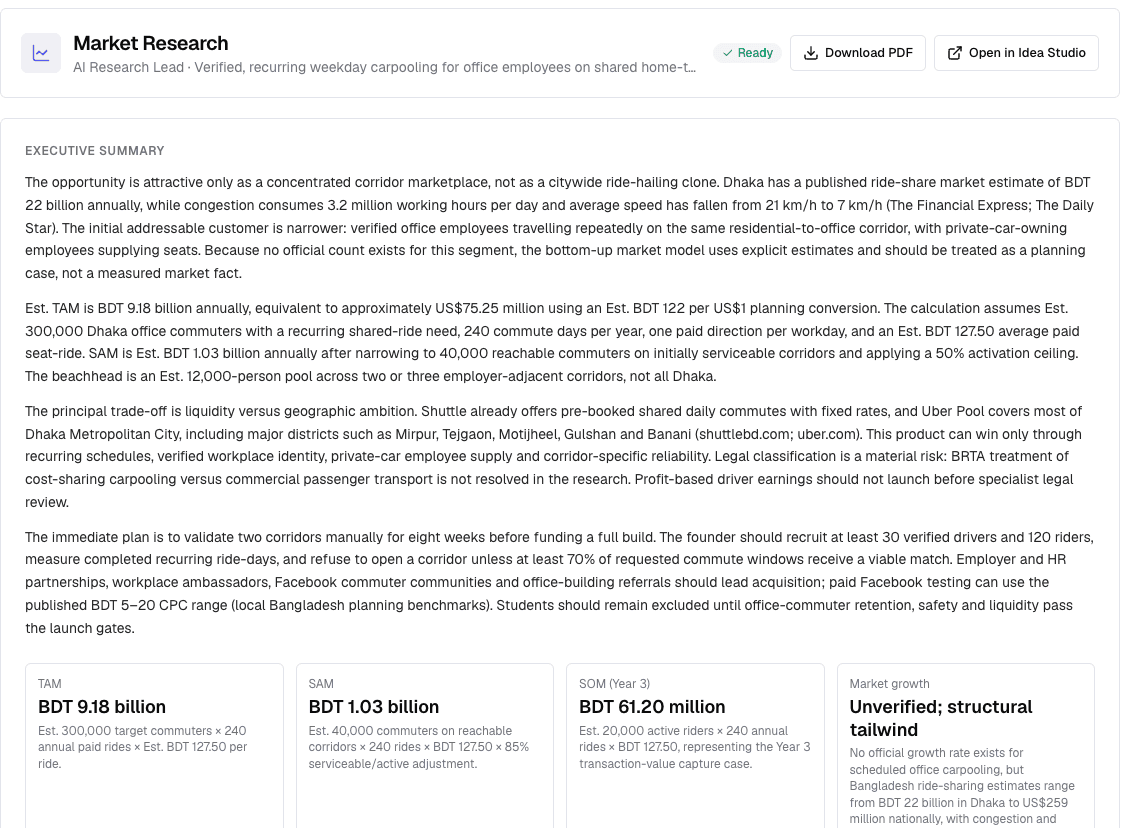
Market Research
AI Research Lead
TAM/SAM/SOM built bottom-up, assumptions shown
Business Blueprint
AI Strategist
Model, pricing, unit economics, moat
Product Requirements
AI Product Manager
Features, flows, acceptance criteria
Tech Architecture
AI Solutions Architect
Stack choices with the trade-off written out
Frontend Plan
AI Frontend Engineer
Route inventory, states, component map
Backend Plan
AI Backend Engineer
Data model, endpoints, jobs, permissions
Marketing & Growth
AI Growth Marketer
Channels, budget, first 90 days
Pitch Deck
AI Pitch Coach
15 slides, speaker notes, exportable
Launch Timeline
AI Project Manager
Week-by-week plan to first users
03/Where the numbers come from
A plan you can argue with
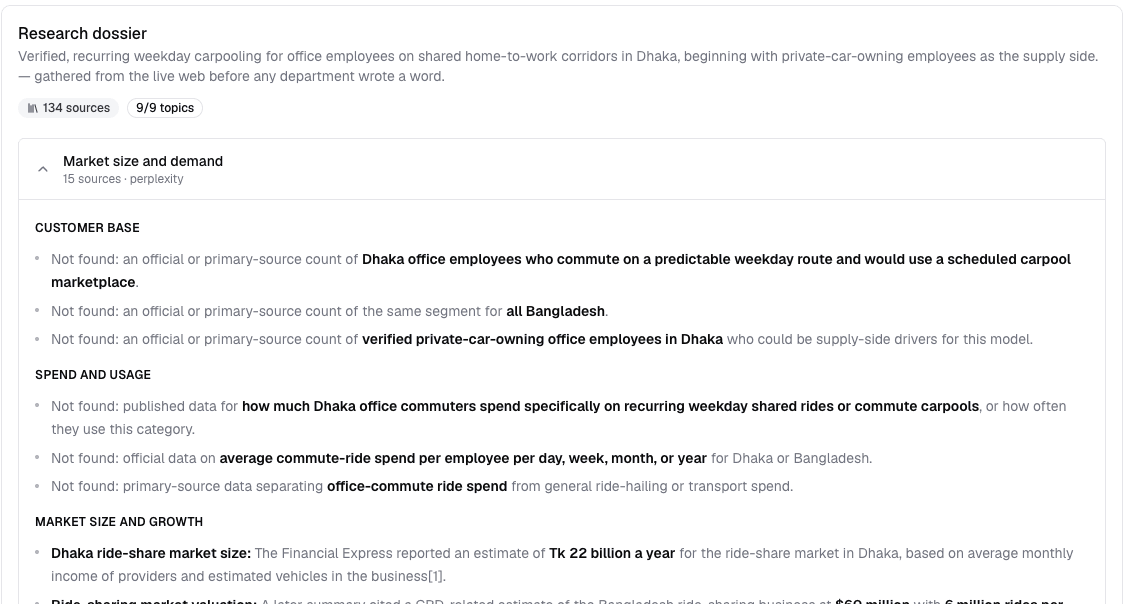
Anything can generate a confident business plan. The useful part is being able to check it. Research is gathered first and kept, so you can read what the model read, follow the link, and see the date on it.
- 'Uber-Pathao' ride-share's impact on DhakaThe Financial Express2026-02-26
- Commuters in a bind for lack of transportThe Daily Star2026-09-22
- When rain turns Dhaka’s commute into a second jobThe Daily Star2026-07-09
- Dhaka, your UberPOOL is hereUber2026-07-04
- Bangladesh is in utter need of a policy frameworkdatasense.services2025-10-20
Five of the 134 sources behind one plan. Topics researched: 9.
04/What you walk away with
Things you can send to someone else
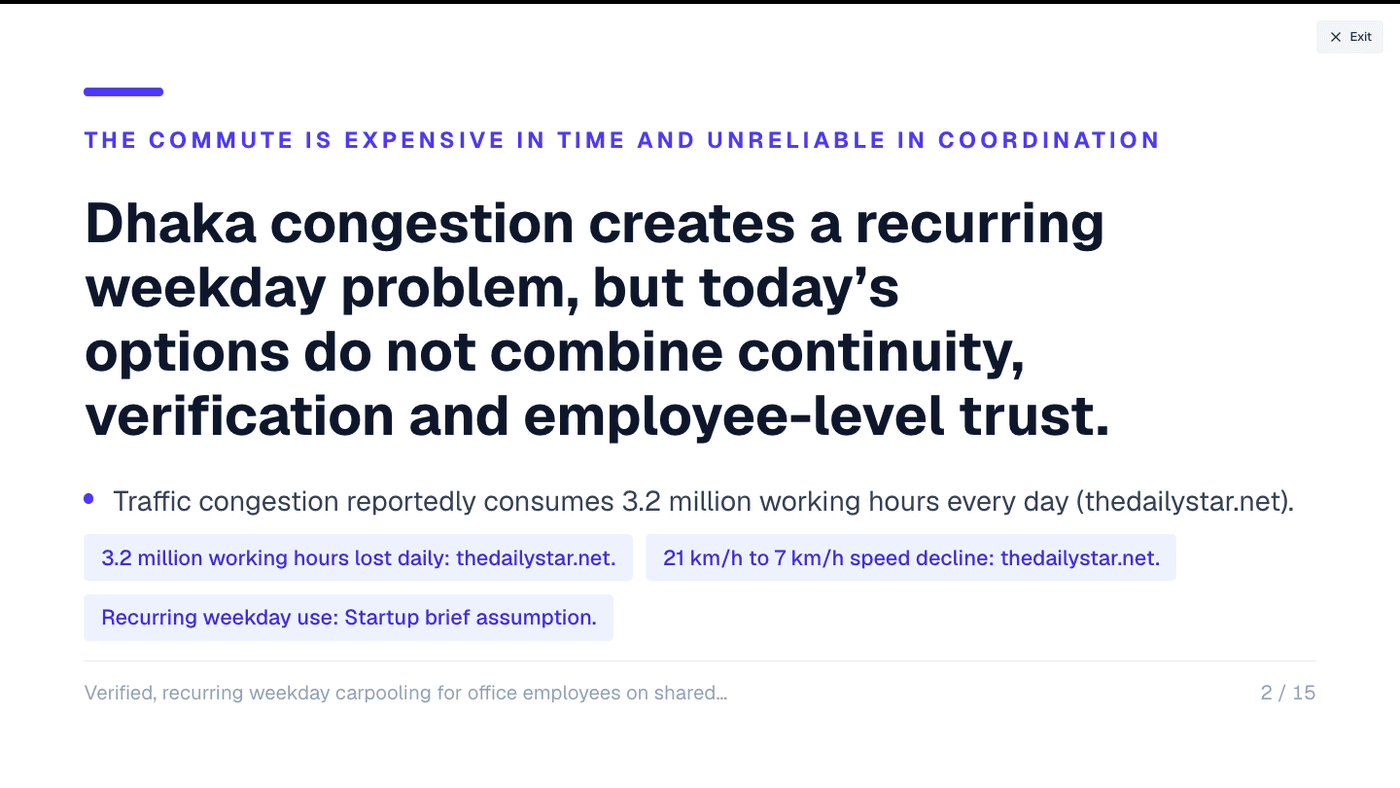
- A deck that presents
- Fifteen slides with speaker notes. Present full screen straight from the page, or download a 960×540pt landscape PDF with selectable text — no print dialog.
- Every report as a PDF
- Printable views for all ten departments, formatted for paper rather than screenshots of a web page.
- Promo posters
- The marketing plan becomes ad copy, drawn into one of six templates, square or portrait, downloadable as PNG. A different angle each time you generate.
05/Honest limits
What it does not do
It does not register your company
Licence and tax research is a reading list with sources, not filed paperwork or legal advice.
It does not write your product
You get a PRD, an architecture and a plan for the frontend and backend. The code is still yours to build.
It cannot verify what nobody published
Where no official figure exists, the report says so and labels the estimate, rather than inventing a market size.
It is not a chatbot you supervise
You do not prompt ten times. You describe the idea, and it comes back with documents.
06/Questions
How long does one idea take?
Under five minutes end to end. The run is capped at five; whatever is finished is kept, and anything that missed the deadline can be regenerated on its own.
Which models does it use?
Perplexity Sonar for grounded research with citations, and OpenAI for the writing, with strict JSON schemas so every report has the same shape. Research topics can be routed to either provider.
What happens to a non-software idea?
The engineering departments are skipped. A gym or a bakery gets validation, market, blueprint, marketing, pitch deck and timeline — and those go deeper.
Can I regenerate one department?
Yes. Each department is its own record; a failed one can be retried without rerunning the other nine.
Is my idea used to train anything?
No. Your ideas, reports and research stay in your own workspace, scoped to your account.
Bring the idea you keep rewriting in your notes.
Four minutes later you will know what it costs to start, who already does it, what the law says, and whether the numbers hold. Including the times they do not.